Editor's note: Meet Michael Swanson (aka Nutter). Michael is new to Kineticist and will be focused on writing about pinball restoration, from experts in the space like Leebo to helpful processes and tricks of the trade. Enjoy!
What first drove me to Leebo’s YouTube channel was, let’s be honest, shiny thumbnails of sweet-looking machines. But as I dove in and binge-watched a few of his restoration efforts, I quickly noticed that Leebo’s skills are quite extensive. He has documented his work on wood-rail machines from the 1950’s up to the A-List machines of the 1990’s.
Like what you're reading?
Get pinball news, analysis, and deep dives delivered to your inbox.
Related Posts
The Origin of Leebo
Sometime around 2010 to 2011, Leebo’s wife’s aunt was downsizing. She had a 1991 Data East TMNT machine in her basement, and she gave the game to him and his wife. It had a lot of issues, he didn’t really have the desire to mess with it, and didn’t have room for it in their house at the time, so it went into storage at his buddy’s place for a few years. Eventually, his friend needed space, so it came back to him around 2016. The PinDoc (yes, the rotisserie guy) was a coworker of Leebo’s at the time, and he kindly took a look. Of course, PinDoc was all about it and had it running in no time. Leebo funded the project and shadowed PinDoc, who did 90% of the work. Leebo learned a lot.
Leebo’s education is in mechanical engineering. His career has had him in engineering jobs related to the service, reliability, and sustainability of products in the field. “I've always liked tinkering with things, whether it's mechanical, electrical, or whatever,” Leebo said. “Learning how to work on pins very much started with shadowing my friend, the PinDoc. From there, a lot has been learned by just doing. Learning from others' experiences from Pinside and Facebook posts and watching YouTube videos has been a huge help. Coupling that with just some basic knowledge I have of circuits and mechanical things has been helpful with the projects. Working with a bunch of fellow engineers is also a great source of general knowledge and help along the way.”
Leebo’s Approach
Leebo tends to structure his videos such that each one focuses on how to do a specific task. For example, polishing metal, repairing or recreating a plastic piece, cleaning a playfield, replacing targets, servicing a score reel, mitigating battery damage, etc.
Without realizing it, I pick up tips and tricks for my own work. More than once, I’ve paused one of his videos and ordered a make your life easier tool he uses. “I started out doing videos a little bit inspired by how Todd 'TNT' Tuckey used to do years ago,” Leebo said. “I think the main reason I started doing videos was to share what all I did to a game so that either the owner (or prospective owner) would know what they have. I have worked on more games that don't belong to me than games I own. So really, it started out as either being an overview of work on a game I was selling or for work I did on someone else's game. Aside from that, I've watched and learned from several other videos. So, I sorta feel like contributing my own back to the world. Structuring the videos by topics just sorta happened over time, and I feel like it makes it more interesting, or if someone is looking for something specific, the videos can be found and are straight to the point.”
One of Leebo's main skills that I’ve been particularly impressed by is his metal-polishing process. When I asked him about it, he was even so kind as to make a semi-dedicated video showing how he worked his magic. I’ll admit, I’m still working on making my parts look as good as he does. If you’re interested, check out Part 4 of his Card Trix series. Here’s an example of him refinishing a shooter rod.
Shooter rod before
Shooter rod after
Here’s another before/after of him giving a lockdown bar for a Bank-A-Ball a 5-minute once over.
Lockdown bar before
Lockdown bar after
Another thing that impressed me while watching Leebo was how easy he made the cabinet repainting process look. For me, it usually takes a long time and a lot of choice words to get through the big, ugly series of events required to repaint a pinball cabinet. Leebo made the process look pretty easy and produced some excellent-looking results. The example that comes to mind is the re-painting of his Lady Luck cabinet. When he bought the machine, one side and the front were painted white, and there were no commercially available stencils at the time. He enlisted some buddies' help, and they made their own. Not an easy task, I can assure you. He stripped the cabinet bare, removed everything, repaired the wood damage, and repainted it. He even took the time to add the speckling that most people skip. He gave the metal parts of the cabinet a once-over and reassembled everything. The end result looks great. Excellent work.
I asked Leebo if he had any comments for someone about to repaint their first cabinet. “I've done this with the Pinball Pimp stencils (and decals from Classic Arcades),” he said. “Generally, I think it's great. It makes a beat-up old game with faded or terribly scratched-up art look new again. But sometimes having the old patina is great, too.”
Lady Luck before
Lady Luck after
The tips and tricks continue from the cosmetic side of the restoration process to the technical side. One example from his channel that seems pretty popular is the connector repair process. Not just repinning a connector, but repairing one that is burnt up, broken, or that needs to be replaced (e.g., the flaky IDC style connectors [insulation displacement]). Here’s an example where he was working through some gnarly IDC-style connectors and converting them to the more reliable, easier-to-manage Molex style. He doesn’t just show how the process is done; he takes the time to highlight each required tool and show its model number.
Something that some people take for granted is the overwhelming process of finding the right tool. When you’re struggling with something and screaming at your screen, “just tell me what to use!”, it’s extremely helpful to have someone say, “This tool works, it’s cheap, here’s the model number, you can probably get it on Amazon (or wherever)”. This is in contrast to most people saying, “You need a set of pin crimpers”. Leebo told me, “I’ve started to do that intentionally because of some feedback I've had in the past. If it can help others, like others have helped me, it makes it more worth spending the time to point it out. It makes the videos a little more worthwhile.” His videos are packed with this type of useful information.
Connector before
Connector after
I asked Leebo to tell me a bit more about the feedback he receives.
“Most of the feedback is folks saying they like what they see and find it interesting,” Leebo said, commenting on his interactions with his audience. “Some feedback offers another way of doing something or helps add to what I shared. And then there is always some feedback that is hard to take, other than negatively, but that's a minority. A big part of my motivation (aside from updating folks on their game I'm working on) is just to simply share what I'm doing and get some more insight. Every game, I learn something new. I often am reminded how much I don't know simply by working on these games and getting feedback. I hope it helps others, but it often helps me, too.” I watch all of his videos and regularly comment, probably pontificating more than I should. But the majority of my comments are, as he says, thanking him for a new way of doing things.
Another aspect I like about Leebo’s channel is that he makes a variety of videos. Most of his videos have an overarching point, as he works through a specific issue. However, he recognizes that not everyone has the time or patience to sit for 15, 30, or even 45 minutes to get through a video. Sometimes Leebo will make a long-form video on a subject, for example, working through cleaning and polishing or removing ball swirls from an entire playfield. Then he’ll follow that up with a shorter 2 to 3-minute video (not a short, this isn’t TikTok!), which shows the skill for those like me with attention challenges. It’s very helpful. Some channels have a vast number of tips, tricks, and how-tos, but finding them amongst the horde is frustrating.
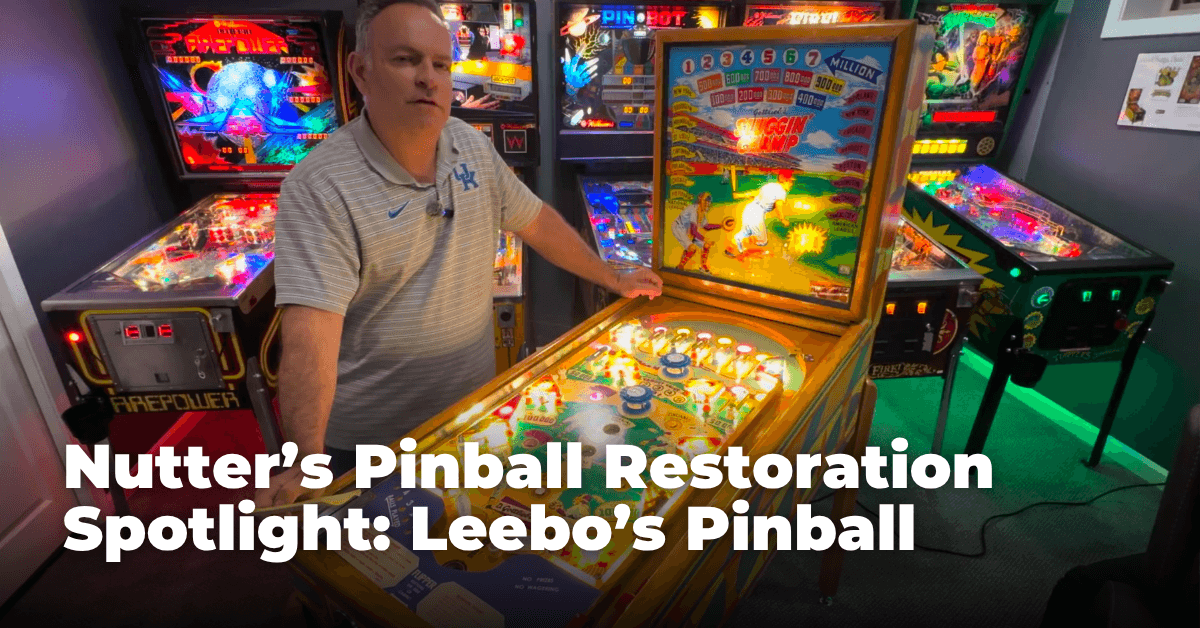
“Sometimes I'll end up with a series of several videos taking folks through the whole process I'm going through,” Leebo commented on his video-making procedures. “I don't know if I'll have a couple videos or a dozen before it's all done. A lot of times, the videos are taking folks along for a ride while I'm figuring issues out, pretty much real time. That said, I try not to bore folks with unnecessary content. For example, one of the last games I worked on, a 1955 Gottlieb Sluggin Champ, ended up being about 12 videos. I didn't keep track of all my time working on this game, but I bet it's somewhere around 80-100 hours. Really crazy and several more than I expected on this game, but I committed to getting it done for the customer that brought it to me. This was the 3rd game I did for this customer, and wanted to make it right. Of course, there are not 80-100 hours of video; only the highlights. The last video I did for this game was ultimately a summary of everything I did. Although the owner has been watching the videos along the way, so that he can keep up with progress. The final video could be something he shares with others or wants a refresher of basically everything that was done, in just a single video.”
Here’s an example of his work on a Bank-A-Ball, where he made a long-form video about playfield cleaning, followed by a short video where he quickly showed how to remove the ball swirls.
Ball swirl before
Ball swirl after
I’m a sucker for two things. One is bringing machines back from the brink; the other is taking the time to fix someone else’s horrible “repair”. When Leebo started working on a North Star, the wiring caught my attention. The machine had been visited, as so many have been, by furry friends. These friends had eaten some of the wires. Whoever tried to repair it just stuck some electrical tape over the wires and called it good. Leebo took the time to properly resolve the issue. He cut out the bad sections, replaced them with new wire, and properly routed the harness so it wouldn’t look like a rat’s nest. Nice work.
Wires before
Wires after
Leebo also does minor board repair here and there. He shows the tools and equipment that he uses along the way. It’s a quick reference guide for ideas when tracking down an issue.
The Philosophy
After chatting with Leebo for a while, I was curious. I asked him about his restoration philosophy. A rather open-ended question, but most people have a good answer. It usually outlines what motivates them and keeps them in the pinball hobby for such a long time, and most people can chat over a beer, or, you know, six, about what they enjoy most.
“It depends,” Leebo started. “If I'm working on an old EM, I tend to want to make them look original. That said, I tend to still use warm-white, clear-lens LEDs to bring out the brightness and minimize heat under plastics. For some colored inserts, I tend to use a matching color just to make them look more like a solid color than a white, washed-out hot spot. If I'm working on an SS game, especially some of the later models in the late 80's or 90's, I sometimes get a little more creative with adding more light sockets, spotlights, strips, etc., mainly to brighten up dark spots. I've been pleased with this approach most of the time, but depending on where the game is going, I've had to approach this a little more conservatively. For example, I restored around 10 different games for Pinball Garage in Hamilton, OH. The owner of the arcade gave me liberty to get creative and make games that really stand out. However, some of the mods haven't weathered well over years of being on and played several hours a week. Things like light strips start to dim over time, or the adhesive will come loose. This makes for a mod better served in an HUO environment than in an arcade. Another philosophy I have when it comes to LED lighting is that I'm a big fan of softening flicker harshness. For system 11 and WPC games, I often use the OCD LED boards that alter the pulse width modulation such that the flicker is much less noticeable.”
I dove a little deeper, asking what his favorite part of the restoration process was. “The most gratifying is probably the lighting,” Leebo said. “Just making a game easier to see what the heck is going on really can make the game so much more enjoyable. After that would have to be a good flipper rebuild. A game that feels like an extension of your fingers makes all the difference.”
Leebo’s videos are a wealth of knowledge, extremely helpful for someone like me who’s still figuring out how to improve my own restoration process. I encourage anyone interested in learning more about pinball restoration to subscribe to the channel and start watching.
Watch for videos on his upcoming restoration queue, including the likes of Fish Tails (which will include major cosmetic upgrades and removal of some hacks), Whirlwind (that is totally trashed, inside and out, which will include major board rebuilds and cosmetic work), and a Little Joe (which is missing parts).
Michael Swanson likes to get lost in his ongoing midlife crisis by deep diving into the details of pinball restoration. He gets carried away with his own pinball projects and likes to follow various other individuals that share his interests. His Kineticist focus will be on highlighting various pinball restoration experts, processes, tools, and tips. He is a Mechanical Engineer, and lives in the Houston area with his wife and two young sons.
Michael documents his restorations in two places. He uses YouTube to document in video format and threads on Pinside to document in photo format with commentary.



No comments yet. Sign in to be the first.