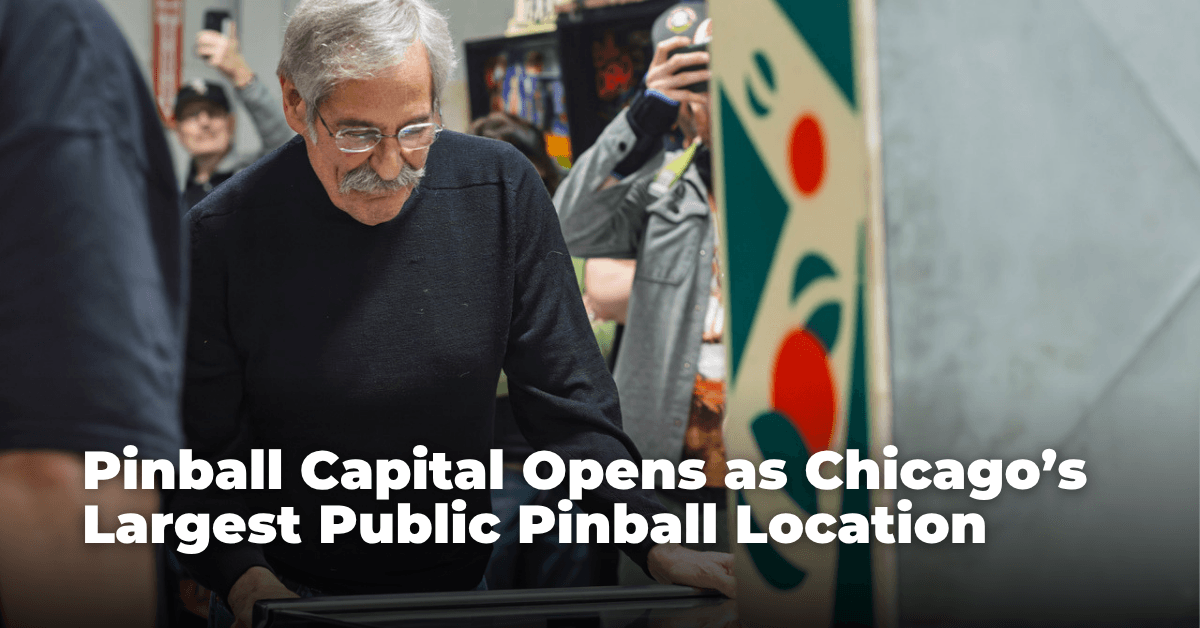
Fifty years after the most legendary pinball skill shot, Roger Sharpe re-enacted his historic demonstration on the first evening of The Pinball Capital’s grand opening events.
Easter weekend at the 131-game pinball mega-location in Stone Park, Ill. - about 30 miles west of downtown Chicago - featured a different kind of hunt for pinball players and enthusiasts.
Like what you're reading?
Get pinball news, analysis, and deep dives delivered to your inbox.
Related Posts
A walk from one room to another in the 7,500 square foot building would reveal a new set of dozens of pinball games from all eras. It might take a visitor multiple trips through to take note of all the games there to be played.
Most were made in or near Chicago, a point that gave The Pinball Capital its name. Notably, Stern and Gottlieb operated factories within a mile of this newest destination for pinheads everywhere.
For competitions, there’s no other place like it in the city that invented pinball as we know it. Andy Bagwell, top-ranked player and tournament director, won’t have any problems finding enough machines to accommodate the largest events here.
"There’s plenty of awesome arcades around Chicago and the country,” Bagwell said after Saturday’s three-strikes tournament. “Chicago’s never had anything like this. 130 games, most of them premiums or LEs, that is not normal for most of the biggest arcades.
“This is an amazing place for tournaments, but also just to play pinball.”
Jeremy Youngman, playing Star Wars (2017)
Early 1960s Gottlieb wedgeheads to the most modern games by Stern, Jersey Jack, Spooky, and other manufacturers are up and running at The Pinball Capital, with a standard $20 entry fee for unlimited play all day.
“I’ve traveled all over the country,” owner Francis Wisniewski says. “I got the idea, there’s no District 82 type place in Chicago? And I just kept waiting for somebody else to do it, and nobody did. So I started looking for real estate. We opened up Kickback, and I met my partner, Jim. That gave me a good year of learning how to operate. Then I found the perfect (building) that could handle 120, 130 games.”
Despite the name and its celebration of Chicago’s prime place in pinball history, there’s plenty of room at Wisniewski’s shrine to the game for machines made outside of Illinois and the United States. Spooky Pinball from Wisniewski’s home state is represented at TPC, along with vintage imports from Spain and Italy by companies including Segasa-Sonic and Zaccaria.
Also on the floor was Gottlieb’s groundbreaking 1946 game Humpty Dumpty, the first machine with flippers that led to the development of the modern game of pinball, though it was not played in the tournaments.
Humpty Dumpty (1947)
“It’s like asking an 80-year-old man to run a marathon,” says Peter Jensen, its owner, who loaned Humpty Dumpty to TPC for its first month, and turned it on periodically to allow interested players to take a flip on a rarely-seen piece of pinball history.
The opening attracted much attention from Chicago media outlets, including WGN and FOX 32, which Wisniewski partly credits for high public turnout to his arcade’s soft open in late March.
Roger Sharpe re-enacts historic 1976 demonstration that ended pinball bans
Roger Sharpe prepares to plunge Ball 3 on Bank Shot, re-enacting his 1976 “called shot" through the upper center gap that led the city council of Manhattan to reverse its ban on pinball machines as gambling devices. The Pinball Capital, April 4, 2026.
Before the tournaments on Friday and Saturday - one match play, one three-strikes, all classics - Thursday was a day of mostly free play, casual pinball for the ticketed attendees, with a break to screen the film “Pinball: The Man Who Saved The Game,” the Roger Sharpe biopic that covered his demonstration exactly 50 years to the day earlier - April 2, 1976 - before the Manhattan City Council that led to New York overturning its prohibition of pinball as devices for gambling. Other cities followed, including Chicago the following year.
Sharpe plunged the ball through the top center lane on his third ball, generating a roar of applause from the assembled crowd, which included his wife, Ellen.
“Number one, Ellen was able to make it with me, and it’s always enjoyable to watch the movie again,” Sharpe said. “And the fact that everyone was sitting and watching and enjoying it.
“It’s a love story... (of) my love of Ellen and my love of pinball. More importantly, I’ve always said the central character of the story is Ellen. I mean, when you really look at what her life was back then, a single mother in the mid-70s, before the women’s movement, knowing exactly what she wanted and being very forthright about it. And much of the movie really is based on facts.”
Bank Shot (Gottlieb, 1976) was the game Roger used in both the original event and the re-enactment at TPC. The machine was a variant of Sure Shot with an add-a-ball feature designed to skirt around bans in some jurisdictions of pinball where replays are rewarded.
After the re-enactment, which followed a ribbon cutting over Bank Shot, which had been moved to the center of TPC’s main room, the game was raffled off and won by David Slaymaker of Rockford.
“I chose (Bank Shot) as my classic game to play in state finals,” Slaymaker said. “A game malfunction during the rather good game I was having on it caused a hump that I was not able to overcome. I ended up losing my round on it, and not by much....it was all quite serendipitous that I actually ended up winning it.”
Sharpe still plays in local events around Chicago. He reached the finals of the Pinball Super League monthly tournament at ENTERRIUM on Tuesday. While he’s been hailed as “the man who saved pinball,” he says that’s a credit that might just as easily go to another key figure in the history of the game - one who headed the only factory making pinball for the first decade-plus of the 21st century.
“I’ve been quick to point out that while I may have ‘saved’ (pinball), that it’s Gary (Stern) who kept it alive,” Sharpe said. “And I think that is really the key, because without Gary filling in that void, you wouldn’t have Jack (Guarnieri) stepping up.”
Jersey Jack entered the pinball space in 2013 with its first game, The Wizard of Oz, starting a wave of newcomers into the scene - and the resurgence of pinball that has elevated the game in the present day to a level higher than any other point in the new millennium, and keeping the ball rolling for Sharpe - now 79 years old - in his golden years.
“I think it’s refreshing now to see a lot of the boutiques and a lot of the people doing homebrew,” Sharpe said. “And I don’t think I’m done (playing) just yet. I’ve still got something in me.”
Brian Weisberg goes 2-for-2 in opening tourneys at The Pinball Capital
Erin Telfer plays Hang Glider (1976) in the final strikes tourney match
If pinball were merely a game of luck suited for gambling, chances are, two tournaments on two nights wouldn’t end with the same player on top.
But that’s what happened at The Pinball Capital on Friday and Saturday, as Brian Weisberg outlasted the field in both the match play and three-strikes tourneys.
“I had a good feeling, because classics is kind of my strong suit,” Weisberg said after Friday’s finish. “I’m terrible at remembering like, the rules and stuff on Stern and Jersey Jack stuff. So, classics is really kind of the fundamentals. But I didn’t think I’d get first.”
Weisberg, a Chicago-area player who had just moved back from Columbus, Ohio, further reinforced Sharpe’s demonstration of pinball as a game of skill and a basis for competition. He entered with an IFPA rank of 3957th and will see his standing go up significantly after taking first place over runners-up in or very near the world top 1000 - True Garlynd and Dave Hegge - in Friday’s match play.
Dave Hegge plays Sunset (1962)
Then on Saturday, Weisberg held on after a spirited comeback bid from another Chicagoland native, Erin Telfer, who now lives and plays primarily in Nashville. Telfer battled back with two strikes to hand Weisberg two and force a winner-takes-all final game on Hang Glider (Bally, 1976). Tom Menge finished third in the strikes event.
“After winning the first one, I figured I’d go 0-3 (in strikes),” Weisberg said after claiming his second top prize. “But, no, I just kind of kept on winning.”
Weisberg was so dialed in that he was on his way to finishing the strikes event with a clean sheet, until the field was reduced to just two players - himself and Telfer, who happened upon the grand opening event during a visit to family.
Brian Weisman flips on Hang Glider in deciding round for Classic Three Strikes victory at The Pinball Capital’s grand opening Saturday, April 4, 2026.
“I was looking on the IFPA map and saw it there,” Telfer said after her close brush with victory. “I thought it looked fun and noticed it was the grand opening.”
At TPC, Telfer found more games under one roof than at her usual location, The Game Terminal, which has 103 games. Telfer also plays in events at Pinranch, a private tournament collection.
“Pinranch is actually at someone’s house, and they built an arcade in the backyard,” Telfer said. “They have about 40 games there.”
Telfer forced a game where winner took all after getting matched with Weisberg on Stern’s Meteor (1979), which she named as her favorite game at TPC. She echoed Weisberg’s belief that in classics, anyone with sound skills can win without being a walking encyclopedia of advanced modern game rules.
“I feel like it evens the field a little bit,” Telfer said. “I’ve tried to bring some friends into pinball who get a little intimidated by games like Foo Fighters, where it seems like you have to know all the modes and ways to get a multiball. (Classics) are great for just playing and having a good time.”
Silverball Super Showdown, youth events on deck at The Pinball Capital
The opening tourneys are just the first of what will be many events at TPC, ranging from weeklies on Wednesdays and Thursdays to the upcoming Silverball Super Showdown on June 26, which will be the location’s first Stern Pro Circuit Tour event.
There may not be a better place for major tournaments in pinball’s hometown than The Pinball Capital.
“You could have 10 games go down and still have plenty (working) to use,” Bagwell said.
As of publishing, Bagwell said there are seven tickets remaining for the June tournament.
TPC will also be a hub for Fliptastic Youth Pinball Club, a league based in Chicago’s west suburbs for pinball’s next generation of players, which will run events every Saturday.
FYPC has held tournaments at ENTERRIUM in Schaumburg and Yetee Station Arcade in Aurora. Director Francis Mai-Ling said the newest addition to Chicagoland’s pinball scene will provide a larger variety of selections for young players.
“What is great (about TPC) is the large selection of games from different eras,” Mai-Ling said. “When I started FYPC, the majority of places were modern. Even though my centralized location is ENTERRIUM and has a small variety and different manufacturers, (Wisniewski) has a lot of potential to help kids learn about different eras of pinball to get their own technique of playing competitive pinball.”
After 15 years of covering jocks throwing balls around a field, I've moved on to writing on a "sport" where the ball and the field are under glass. That's why I'm here for Kineticist. I wrote, produced photography and did layout for a few daily and weekly newspapers in Texas, before a few stints living in other parts of the country. Then, I ended up in Chicago in 2019. While I've played pinball since I was young enough to need a stool or chair to see over the lockdown bar, it was only here in pinball's hometown that I took up playing competitively and regularly.






No comments yet. Sign in to be the first.