No Skeletons in Our Closet: The Ultimate Guide to Bally's Scared Stiff Pinball

Like what you're reading?
Get pinball news, analysis, and deep dives delivered to your inbox.
Get pinball news, analysis, and deep dives delivered to your inbox.
Scared Stiff, released in 1996, is a bit of a sad story: Bally/Williams’ pinball division was plummeting in sales. Money was tight, and so Scared Stiff was gutted as far as interesting gadgets were concerned, meaning the game shipped without the intended air-brushed bone flippers, light-up skull pile in the corner, and others. In any case, Scared Stiff is legendary, combining horror with comedy, and is packed to the brim with various innuendos and double entendres, all owing up to the iconic aesthetic of the game’s hostess, Elvira and her B-movie horror theme.
Scared Stiff is often considered to be a sequel to Elvira and the Party Monsters and became the second entry in a trilogy after Elvira’s House of Horrors hit the scene twenty-five years afterwards.
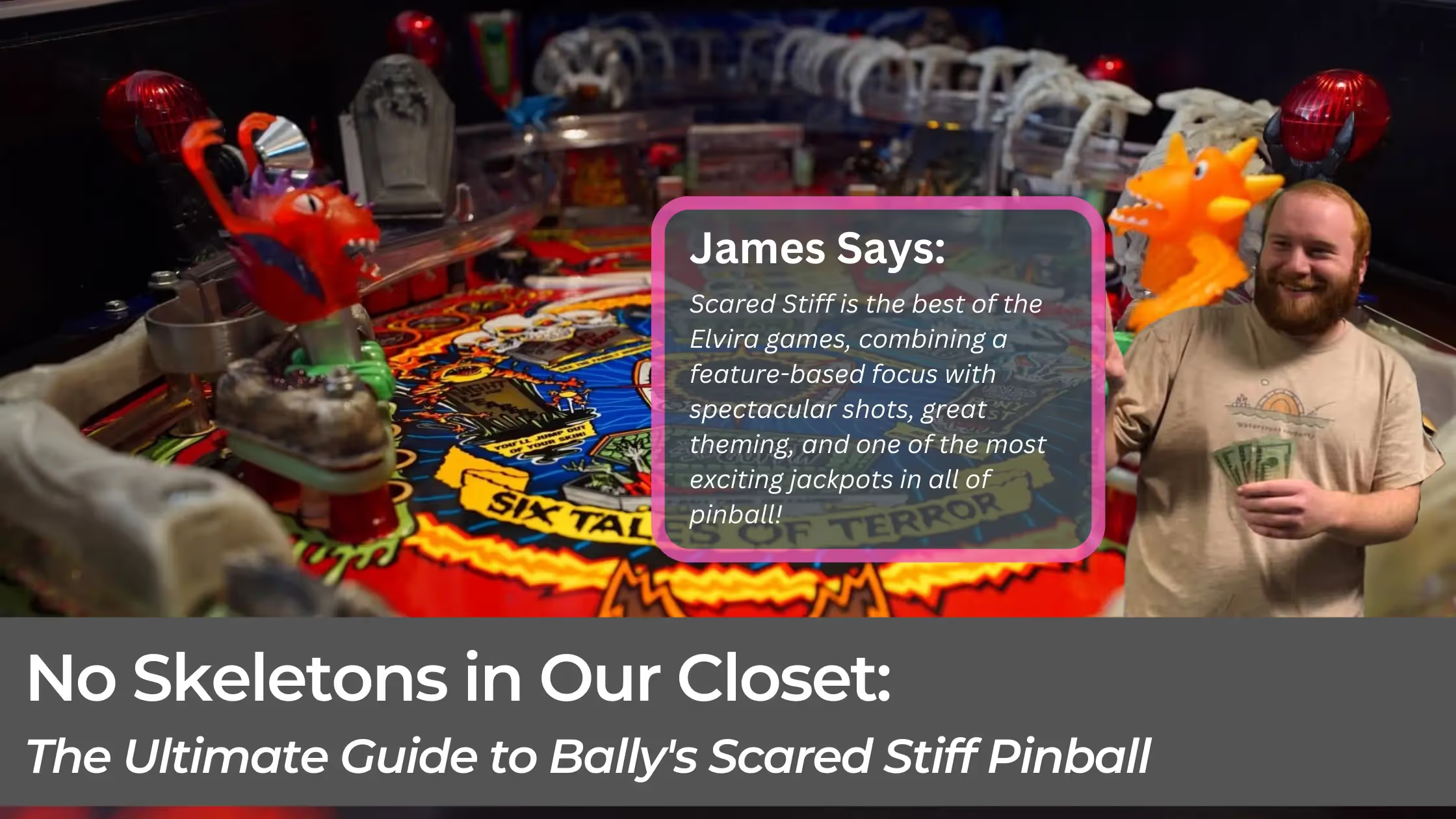
Though opinions will vary, I’ll argue that Scared Stiff is the best of the three, combining a feature-based focus with some spectacular shots, great theming, unique features, and one of the most exciting jackpots in all of pinball.
Scared Stiff is a pinball game manufactured by Bally Manufacturing Co. in 1996. Design by Dennis Nordman, Mark Weyna. Mechanics by Win Schilling, Joe Loveday, Bob Brown. Art by Greg Freres. Code by Mike Boon, Cameron Silver. Sound by Paul Heitsch, Dave Zabriskie. Music by Paul Heitsch, Dave Zabriskie. Callouts by Tim Kitzrow, Cassandra Peterson. Animation by Brian Morris, Adam Rhine. The game features a DMD display, 4 players, 4 multiballs, 2 ramps, and 2 flippers.
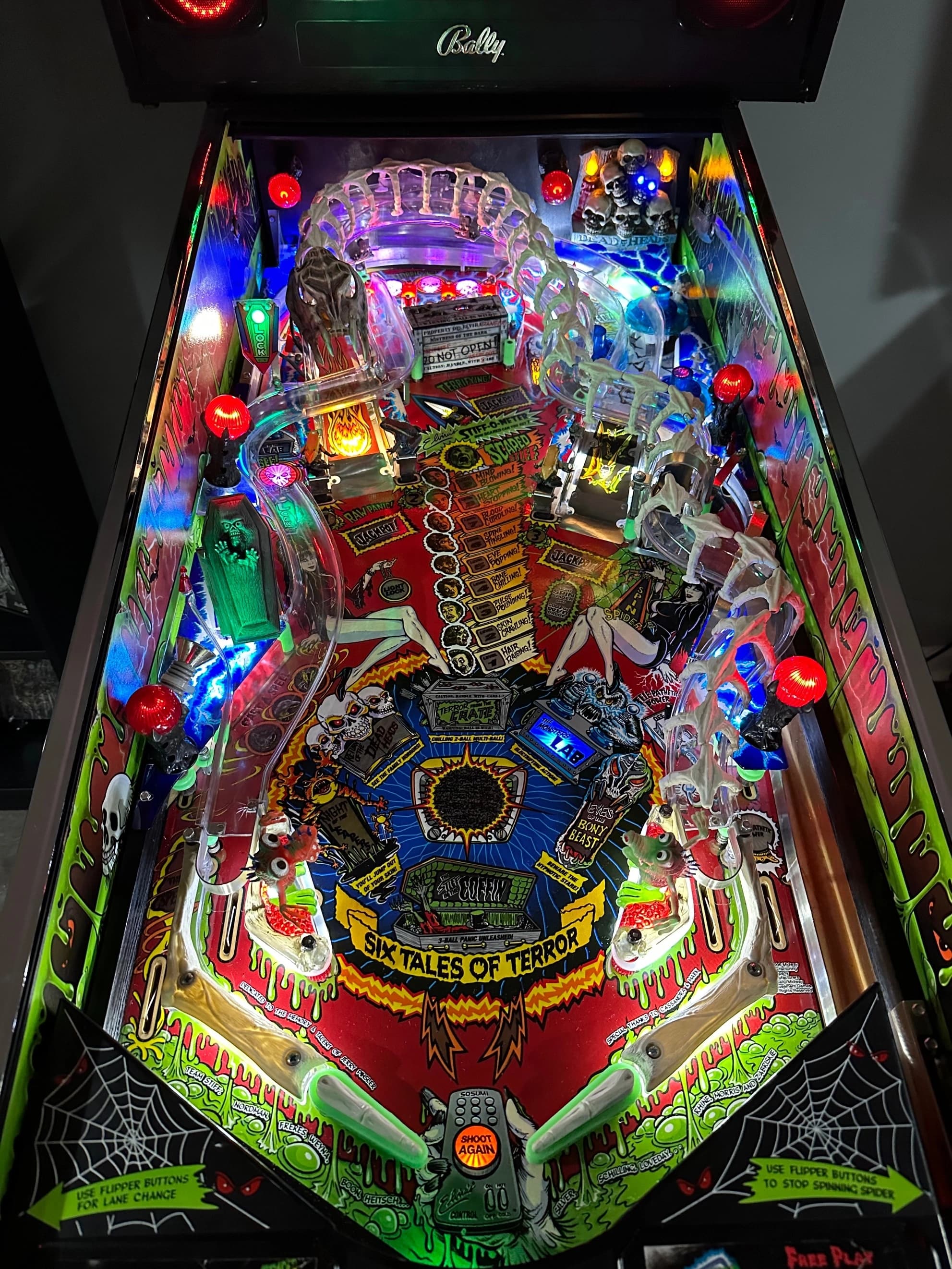
Scared Stiff is considered a “feature-based” game. Basically, rather than the focus being one multiball or a series of modes started at the same spot, the goal is to play around with all the various playfield gimmicks in some way or another. For Scared Stiff, there are six “tales” which have to be collected. We’ll cover all of them later.
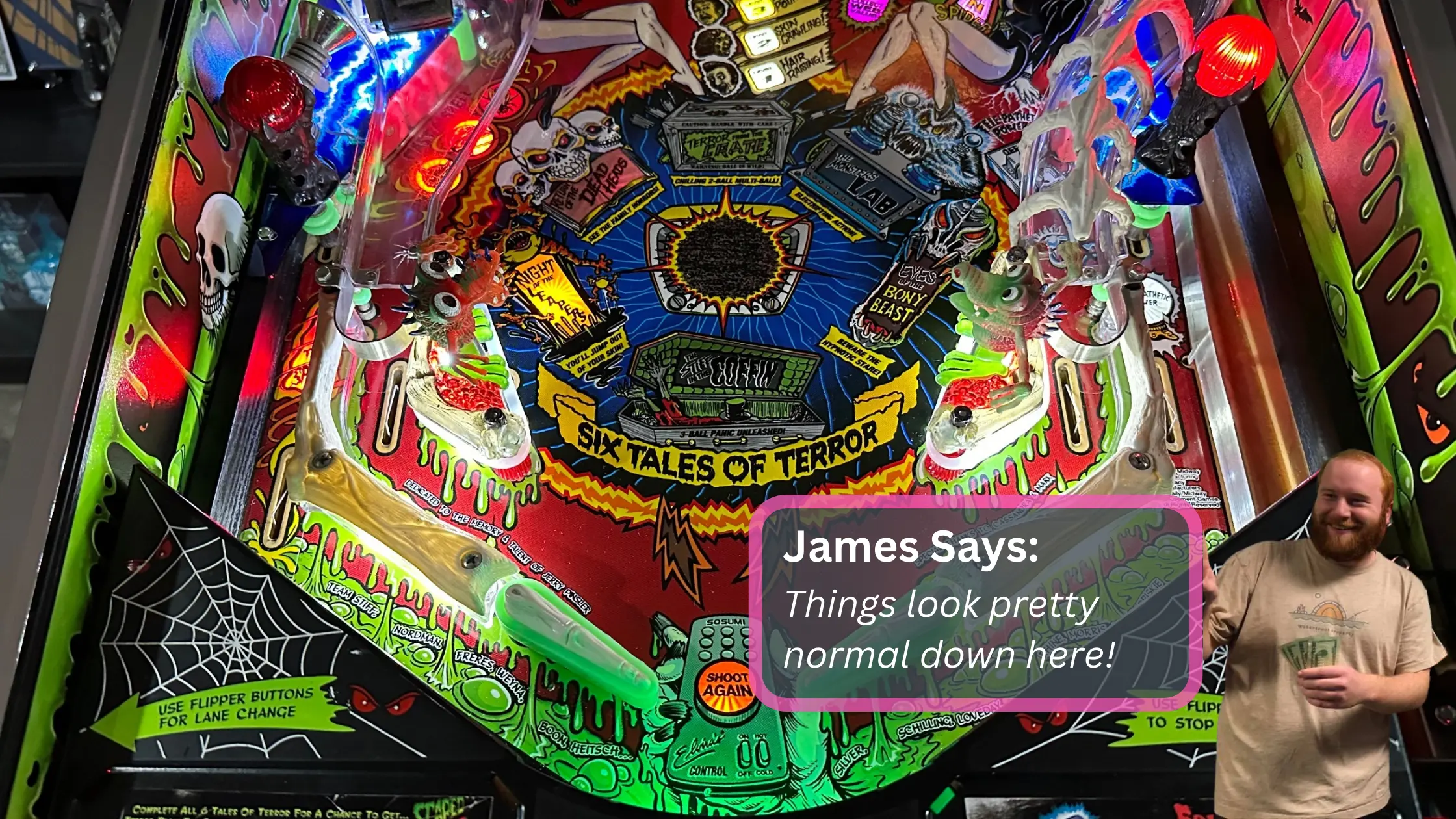
The game has a bit of an unusual layout - from the bottom, things look pretty normal, with some ramps, bumpers, and loops - but up top, things are a bit stranger. There are three lanes that don’t drop down to pop bumpers, three pop bumpers way off to the side that are borderline inaccessible, and a couple of unusual shots up the middle that lead to one or the other.
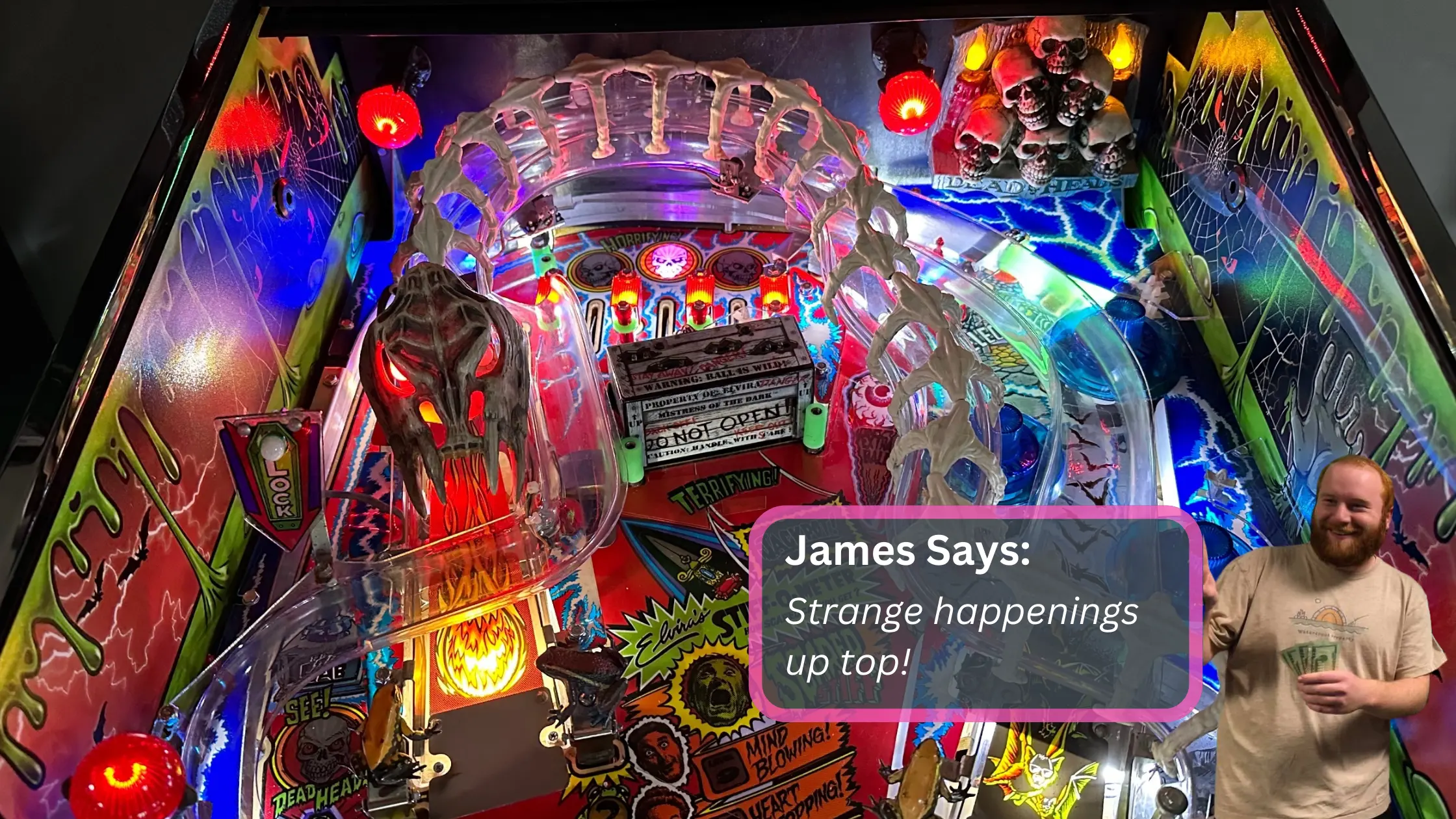
The upper middle playfield is very tight. There’s a kickout hole to the left there that’s important to get comfortable with how it kicks out, though it’s generally pretty unpredictable. The crate shot up the middle is dangerous but can become important. Get used to how to hit it and how it returns balls to you.
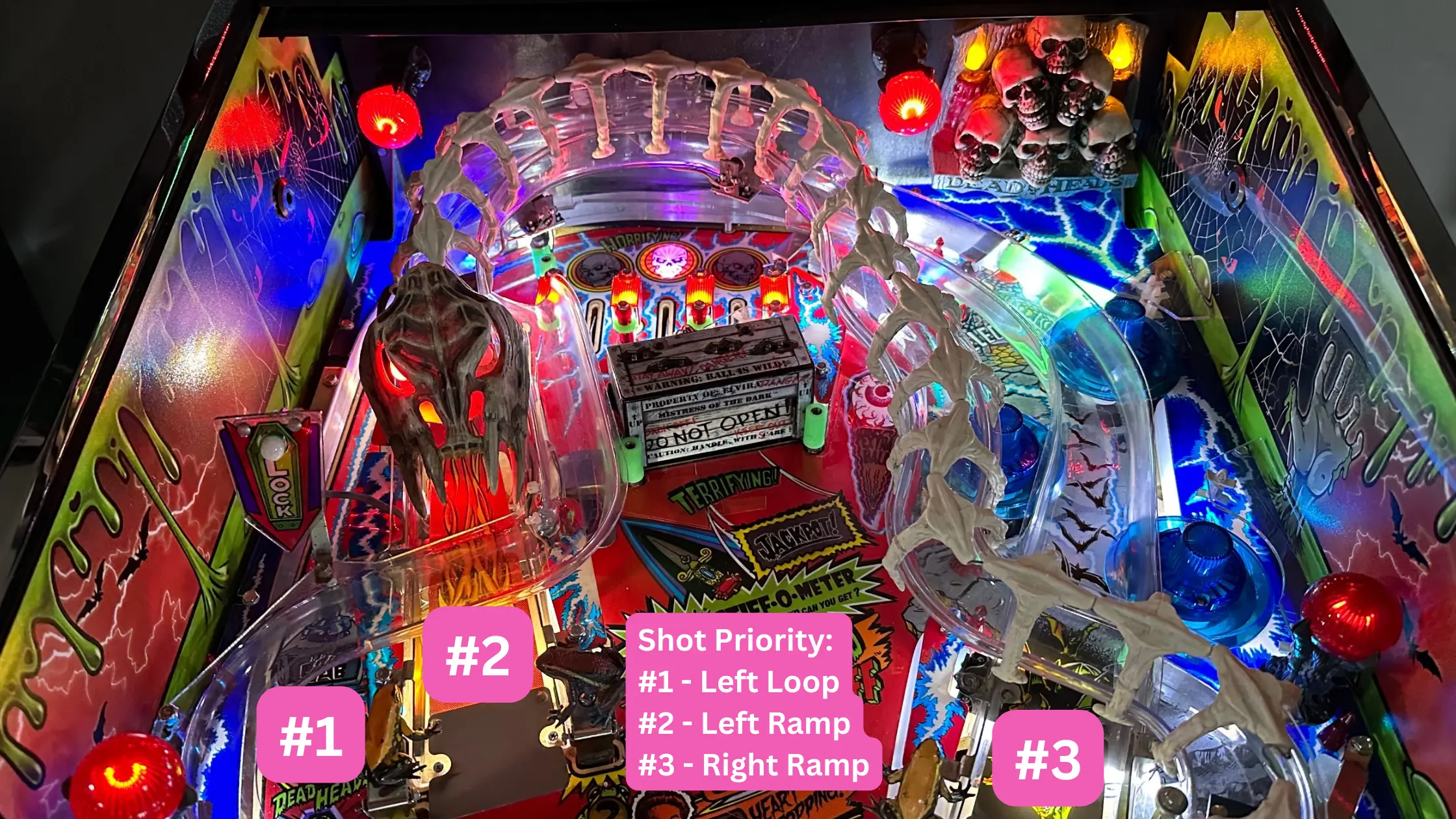
Of all the shots on the table, the loop on the far left is the most important, the left ramp is a close second, and the right ramp is a distant third. Each ramp feeds the same flipper used to shoot it, meaning repeatedly shooting the same ramp is easy.
There is an outlane save called “The Spell,” which is not a kickback, but puts another ball into play. It’s lit by shooting the three-bank of targets over the left outlane a few times. Personally, I find it incredibly difficult and dangerous to light, so I usually ignore it. Just be warned that it typically requires multiple completions to light: if it looks like you’re one target away, you’re probably not.
Scoring in Scared Stiff is surprisingly low when compared to its contemporaries. 5-10,000,000 is pretty solid if the machine is set tough, but you can definitely score much higher if you get far enough into the game.
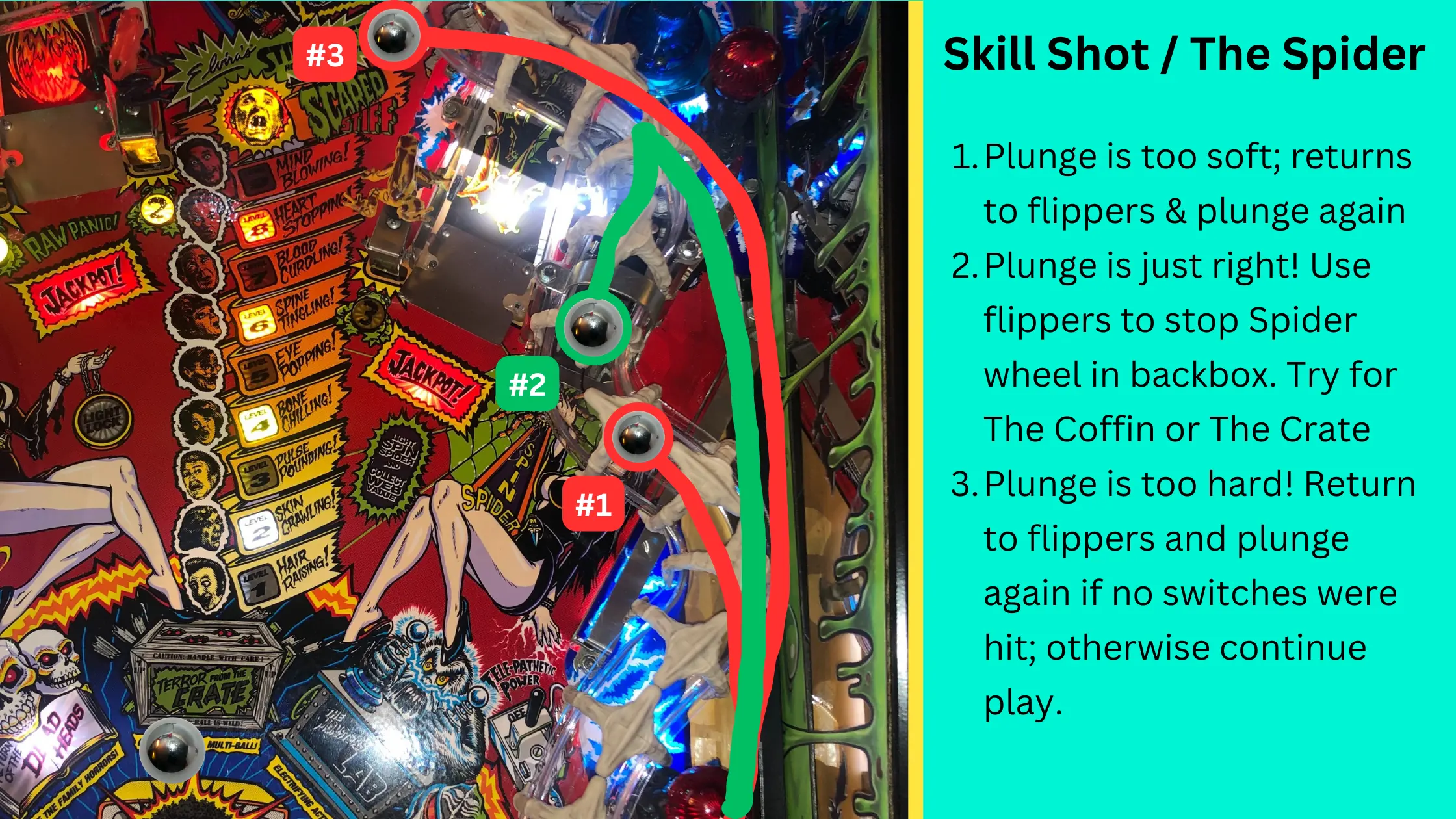
The true skill shot is to shoot the ball into the upper hole, but you should ignore that. Instead, shoot for the “Spin Spider” hole located in the center-right side of the table. This is not only more valuable, but it’s also safer and easier. Basically, there are two gates on the way up. You want to make it past the second gate, but not by much. You’ll end up in a little lane that, if you stay in, the ball will drop into the player-controlled spinning spider hole. Too hard, and you’ll leave the lane; too soft, and the ball will drop to the flippers. You can plunge again if you don’t make it through either gate.
Scared Stiff is one of the few games released in the 1990s with a backbox toy: a spinning spider which awards one of sixteen different awards. Landing in the Spin Spider hole when it’s lit will let you spin the spider, flipping both flippers to immediately stop it and award whatever it’s pointing to, and it gives you one of several different goodies. You control the timing completely - get comfortable with picking the award you want since a couple are very important: the Coffin (at 4 o’clock) and the Crate (at 8 o’clock). Both progress you towards multiballs.
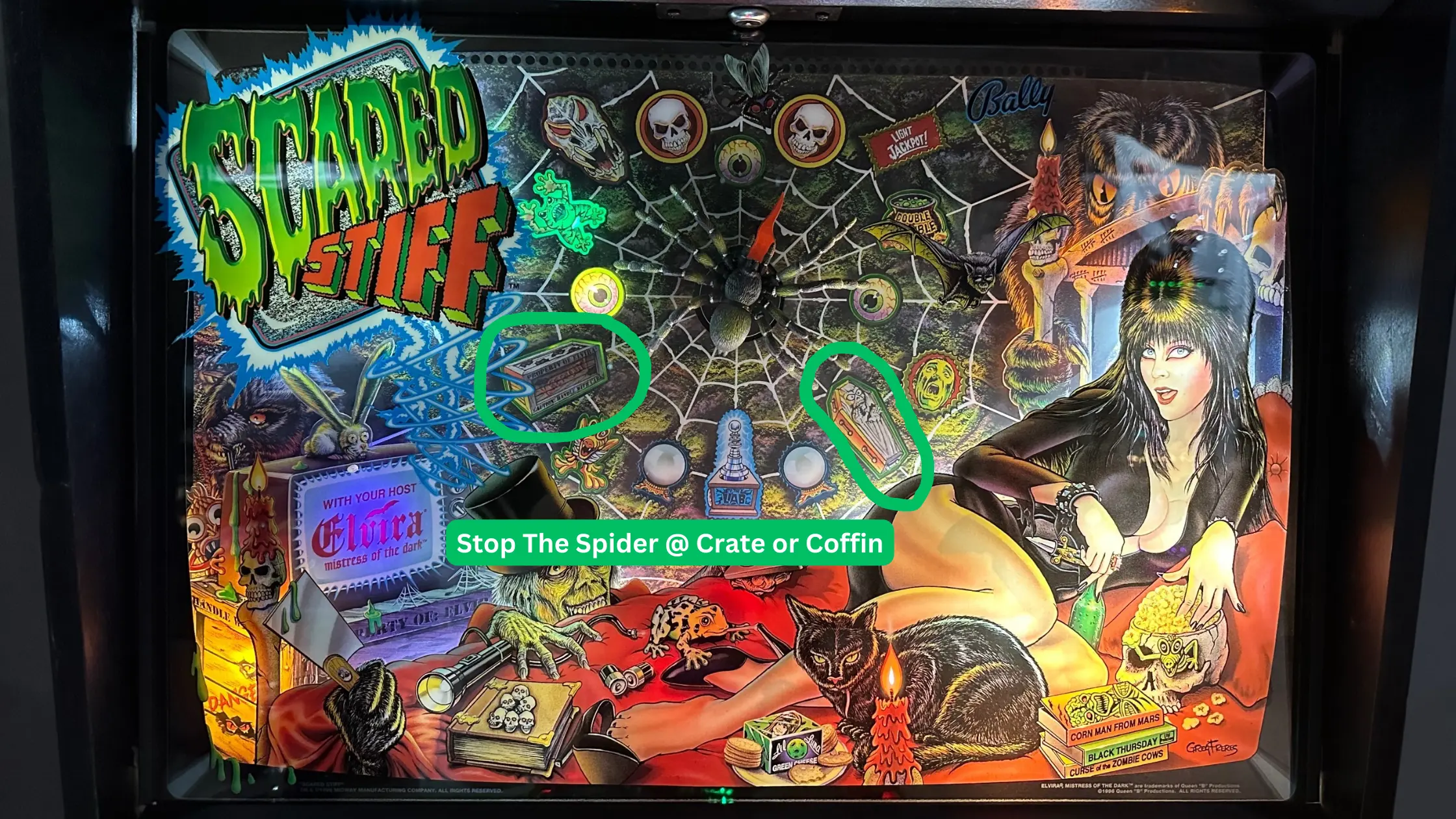
Otherwise notable is “Double Trouble,” which lights double scoring for 20 seconds and should be combined with a multiball, though you shouldn’t delay a multiball to use double trouble. In any case, your first focus needs to be Coffin and Crate. The rest are usually little modes that aren’t worth very much. You can only collect web awards during single-ball play, and the hole is relit on the right ramp.
When you collect an award, it’ll stay solidly lit and can’t be collected again. You don't get anything if you hit something you’ve already collected. Collecting all sixteen starts a wizard mode which I’ve never gotten close to and, frankly, don’t know anything else about.
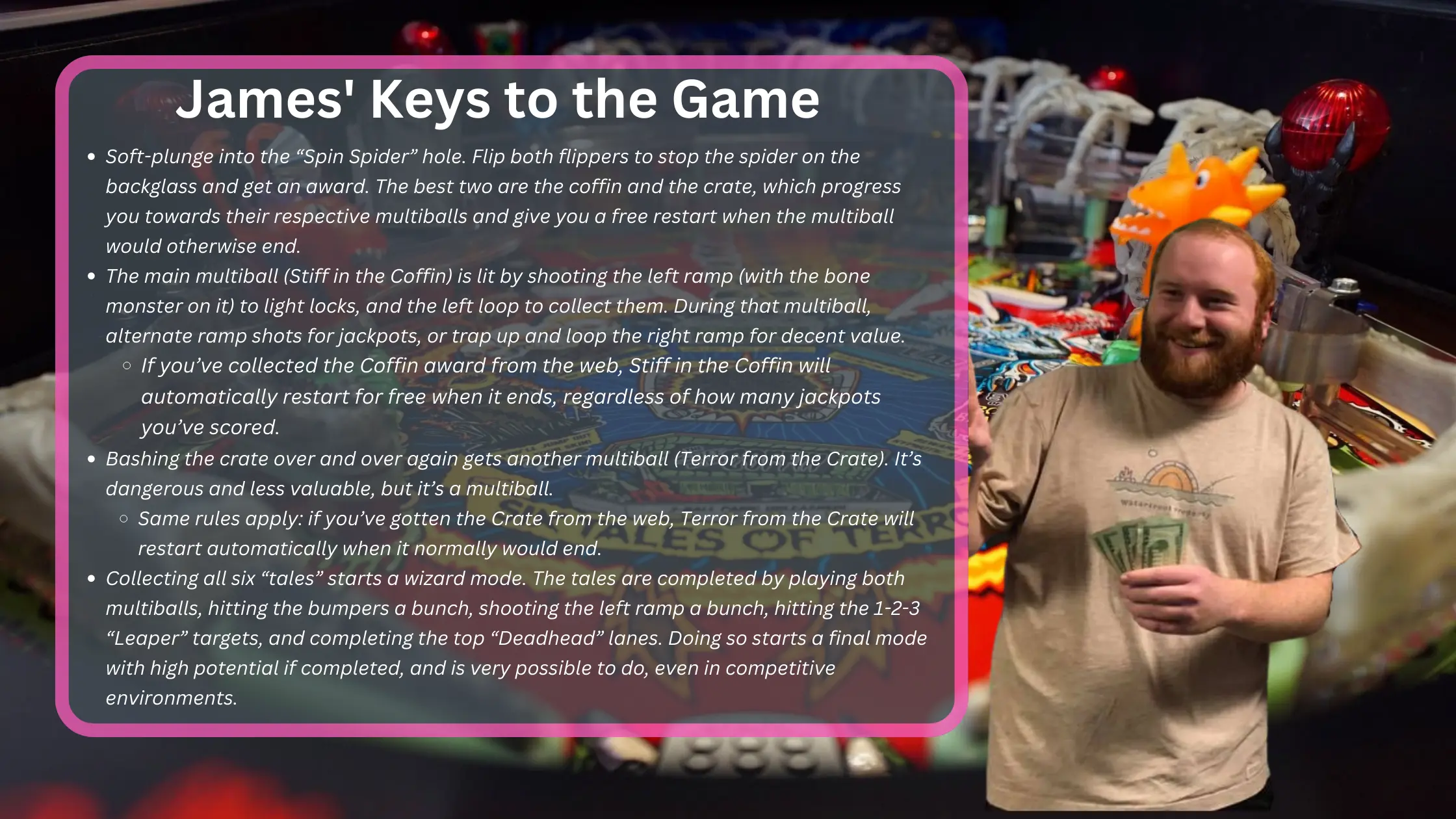
This is the main multiball on Scared Stiff. To start it, you have to light locks by shooting the left ramp a couple of times and collecting the locks on the left loop. Three locks begins a three-ball multiball. During Stiff in the Coffin, the goal is to shoot alternating ramps for jackpots. The first shot can be to either ramp, but each jackpot afterward needs to be to the other ramp. Since the ramps feed the flippers that shot them, that’s easier said than done. There are a few ways to capitalize on this:
Which reminds me - remember how I said, “get the coffin collected on the web?” Well, it doesn’t just advance you towards locks for starting this multiball. It also gives you a free restart when your Stiff in the Coffin invariably ends. That’s right - regardless of how many jackpots you’ve scored, if you’ve collected that Web award when your Stiff in the Coffin ends, it instantly starts up again for free! It might sound too good to be true, but I assure you, it’s true and unbelievably valuable.
Do not start Stiff in the Coffin without collecting the Web award first.
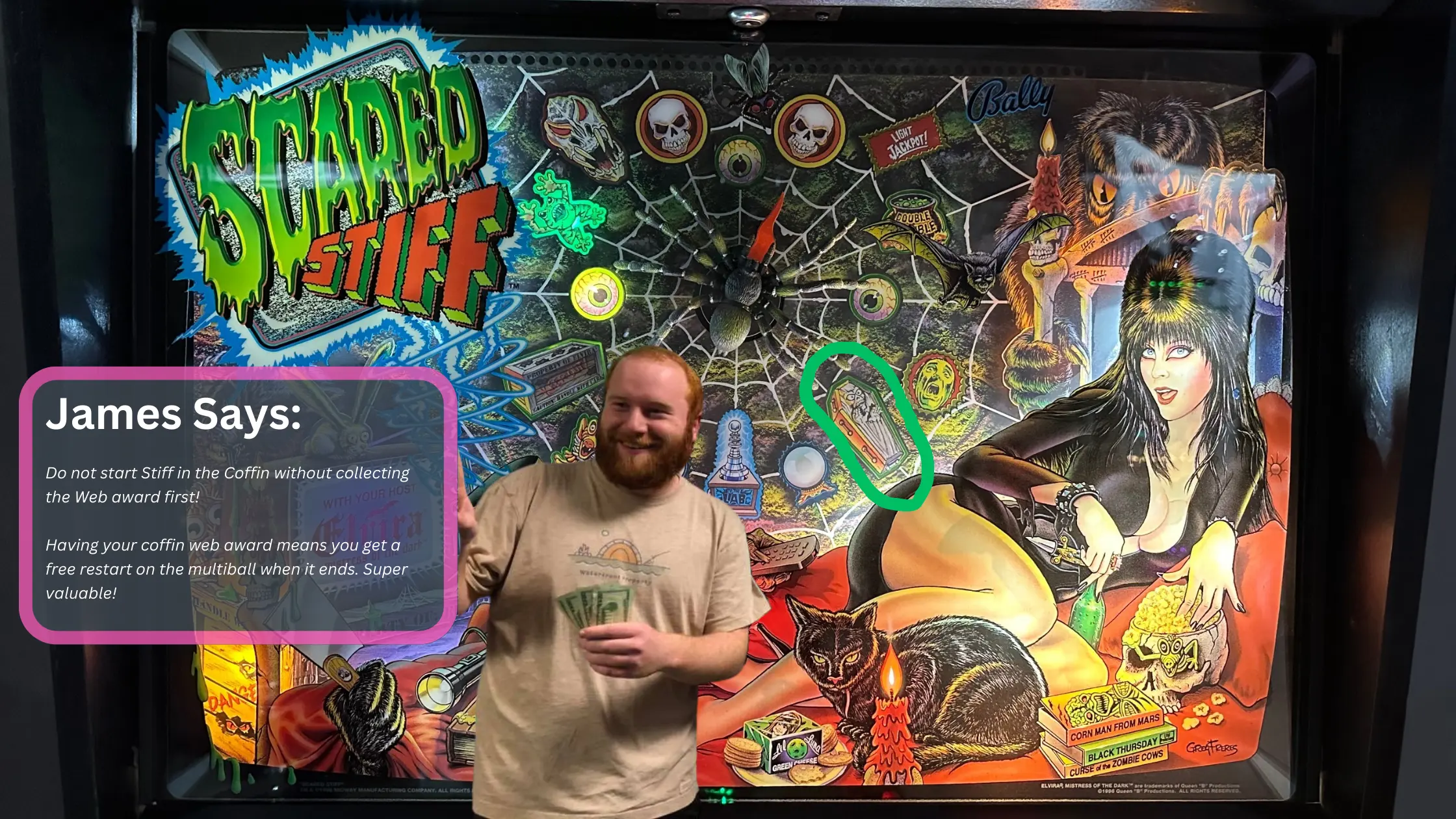
Stiff in the Coffin is pretty valuable, and if you’re comfortable repeatedly shooting the left ramp and the left loop, you can replay it all day. There are other things that we can do that can pay off big time, so if you’re getting bored doing that or are comfortable shaking things up, you can check out some other things on the playfield.
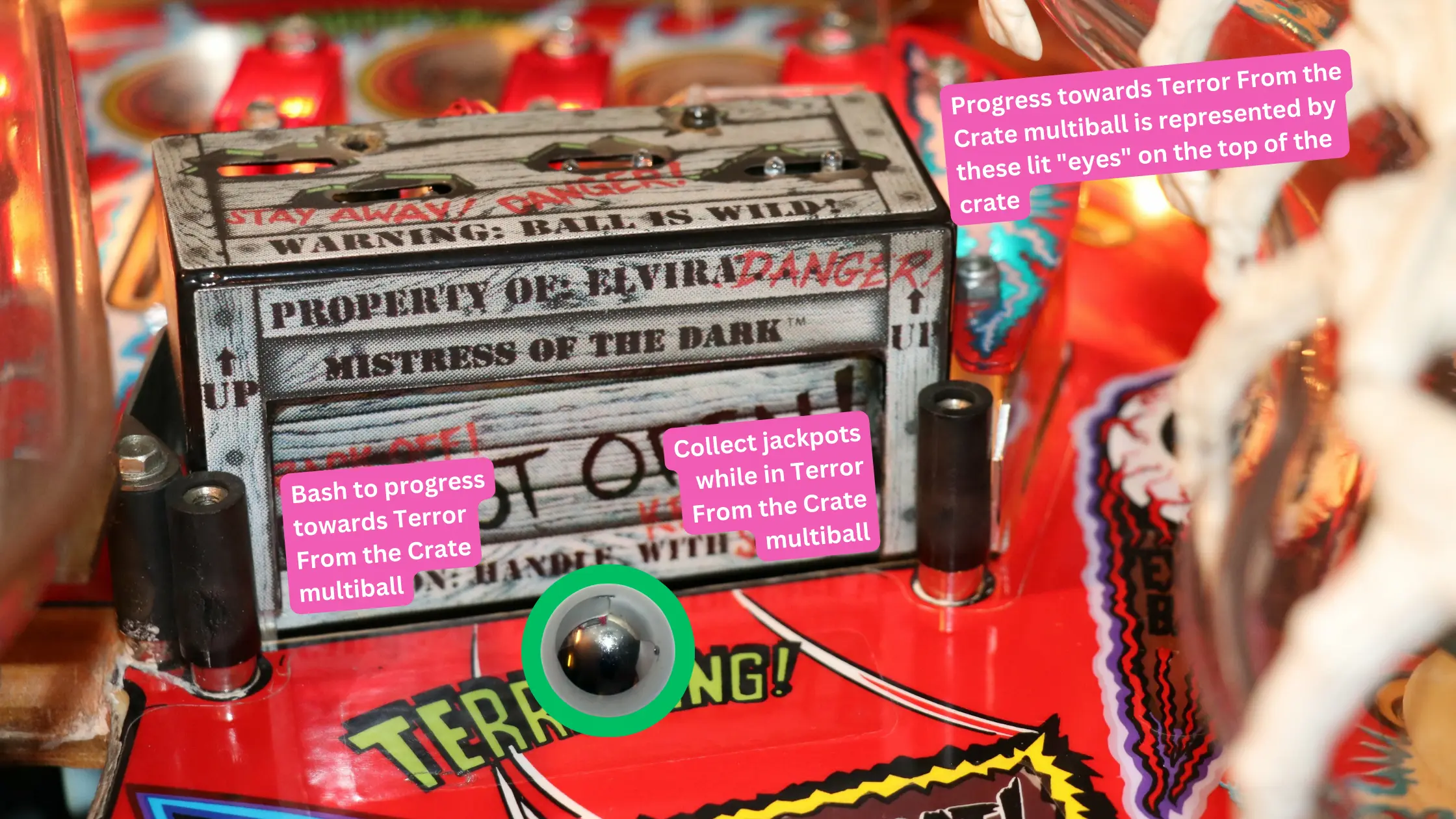
Terror from the Crate is the other major multiball. This is started by bashing the crate at the top of the playfield many times. The “eyes” on the top of the crate indicate how close you are to starting it: when they’re all solidly lit, the next shot to the crate will go into it, and the multiball begins.
Terror from the Crate is a two-ball multiball during which the jackpot is the crate. Unlike Stiff in the Coffin, the jackpot is always lit and can be repeatedly collected. But it’s much less valuable, and the kickout is that upper hole which is obnoxious.
Starting this is much tougher than it might sound; the crate is dangerous and tends to throw the ball out of control. I find that playing two Stiff in the Coffin multiballs is typically easier, safer, and more valuable than playing one Terror from the Crate. That said, during Crate, the best strategy is to just loop the left ramp. While the crate is probably easier, it’s less valuable and more dangerous, since the kickout is so nasty. Honestly, that left ramp becomes so valuable that one could argue that looping it all day is a viable strategy in single-ball play, though I’d say getting through the tales has a big enough payoff that it’s worth shooting for them.
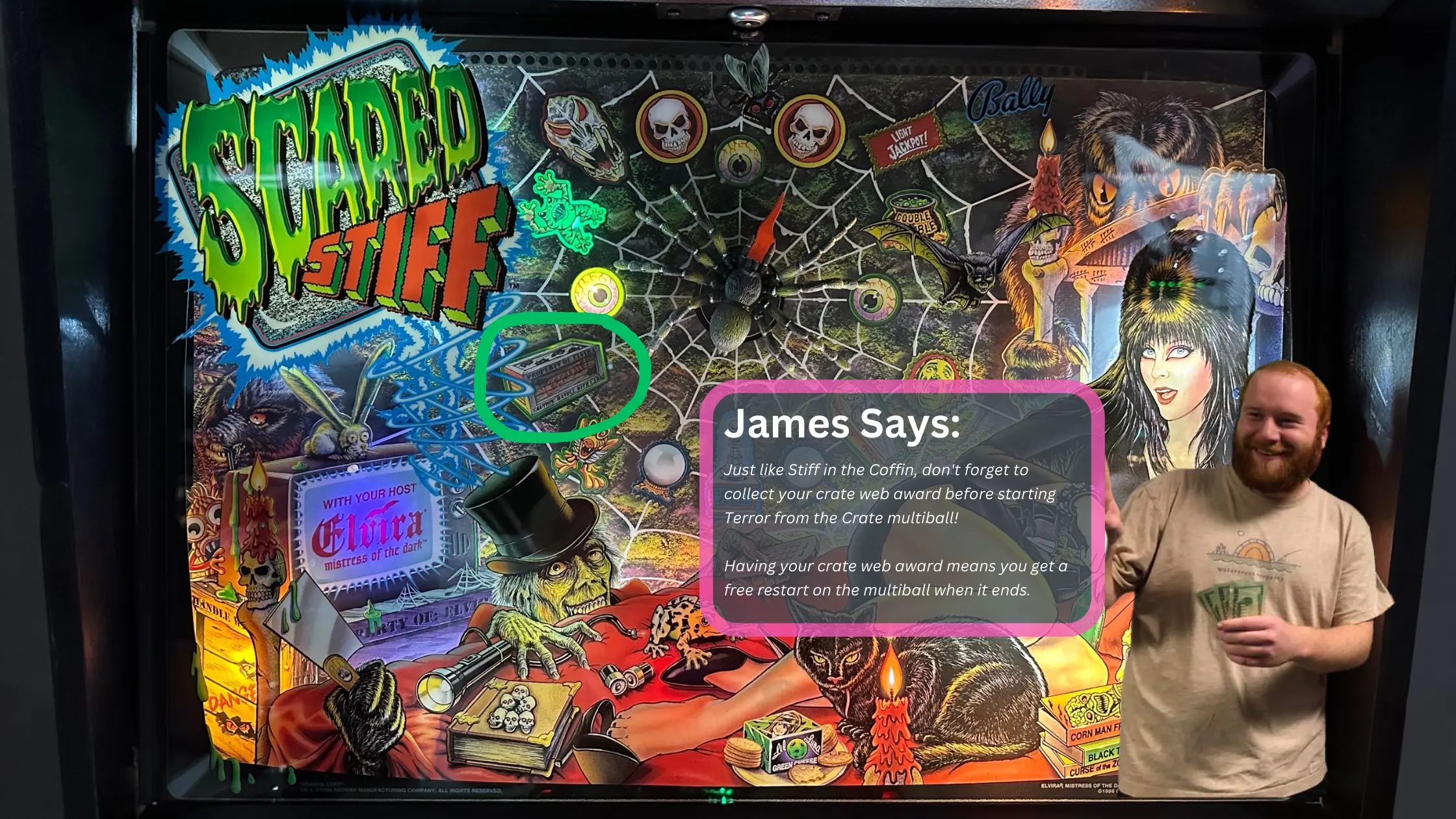
Like Coffin, getting the Crate from the Web is a free restart when the multiball would normally end. Make sure you collect it before starting Terror from the Crate. Also, note you can’t stack the two multiballs - they’re mutually exclusive from one another.
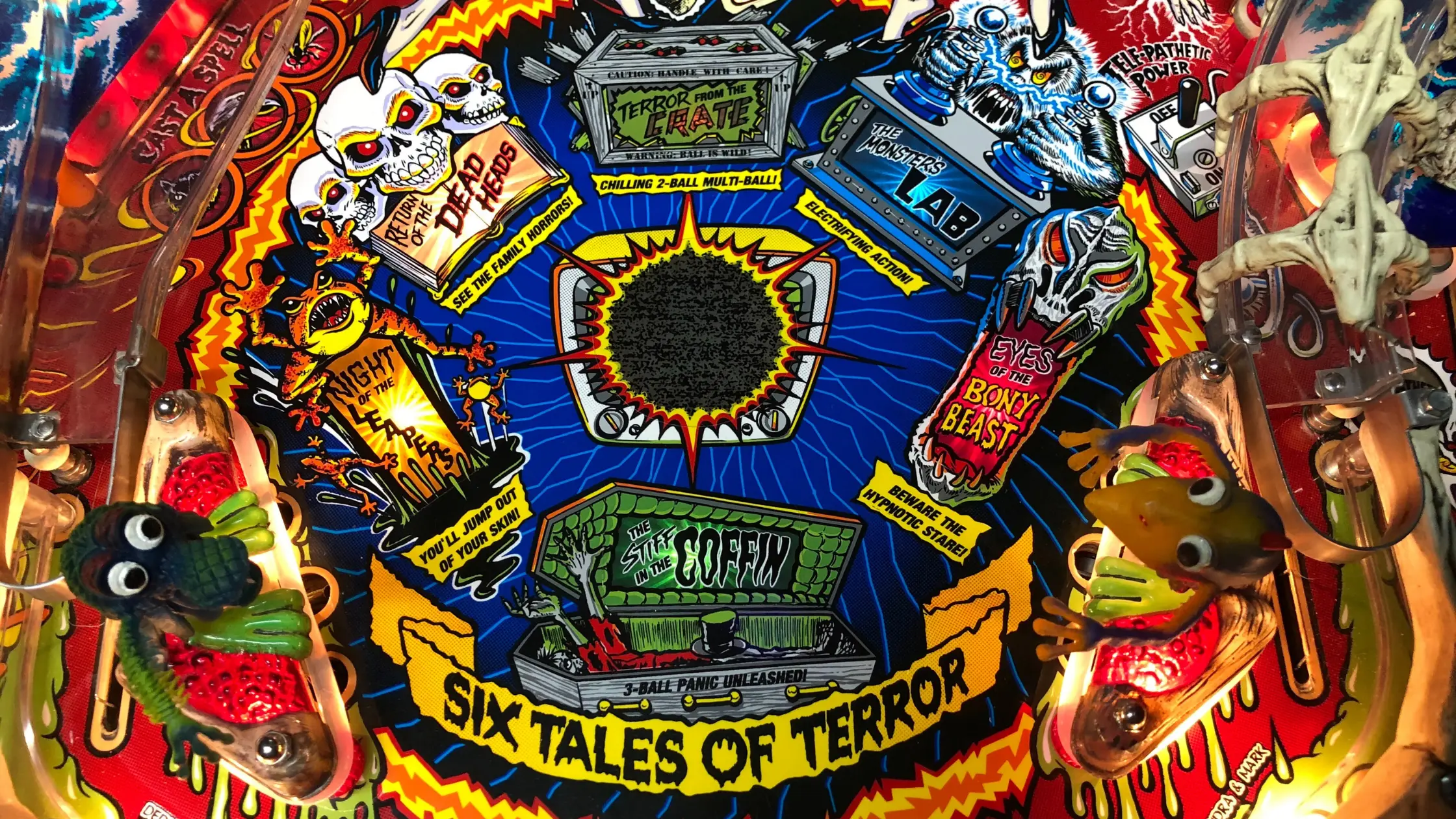
As I mentioned above, the goal isn’t to reach multiball or play all the different modes available but rather to reach some objective with each of the various toys and gimmicks all over the table. There are six “Tales of Terror,” and the goal is to get all six, which starts a wizard mode. Unlike many wizard modes, however, this is very doable. It’s not trivial - I’d say it’s about as tough as reaching Monster Bash is on Monster Bash - but it’s possible. If you’re one or two tales away, your priority should shift to those tales. The six tales and how to complete them are as follows:
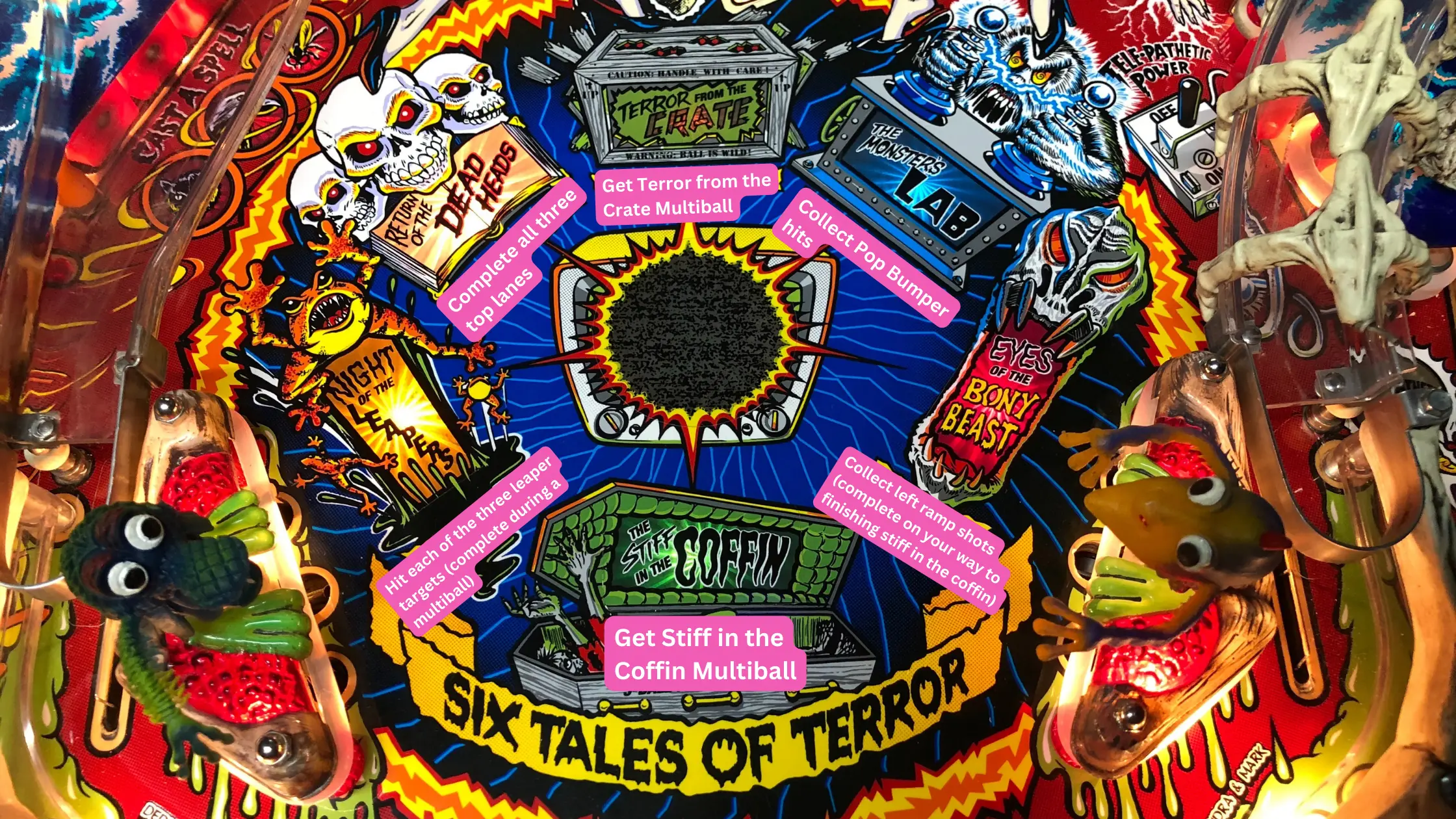
When all six tales are complete, you can shoot the crate to start up.....
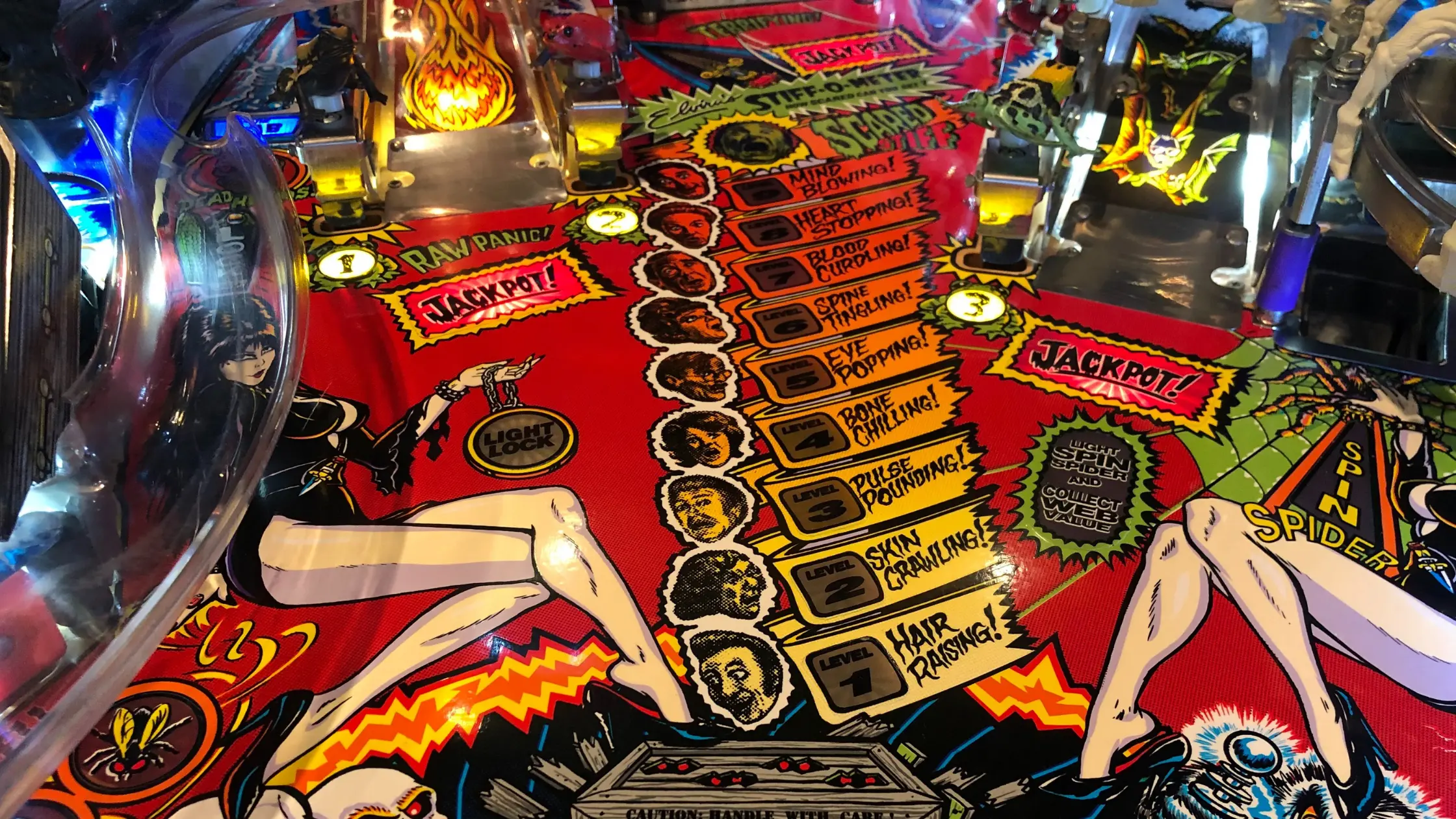
This is a one-ball mode. The goal is to alternate shots to the ramp and to the crate; each shot awards lots of points and increases your Stiff-O-Meter level by one. The goal is to reach level 10 - Scared Stiff - which awards a whopping 5,000,000 points and makes the entire machine go haywire. After that, Monster Multiball instantly begins - a four-ball multiball during which all ramp and crate shots are worth 1,000,000 points a piece and are all always lit. It’s the most lucrative scoring opportunity in the game - even more so if you happen to combo it with Double Trouble.
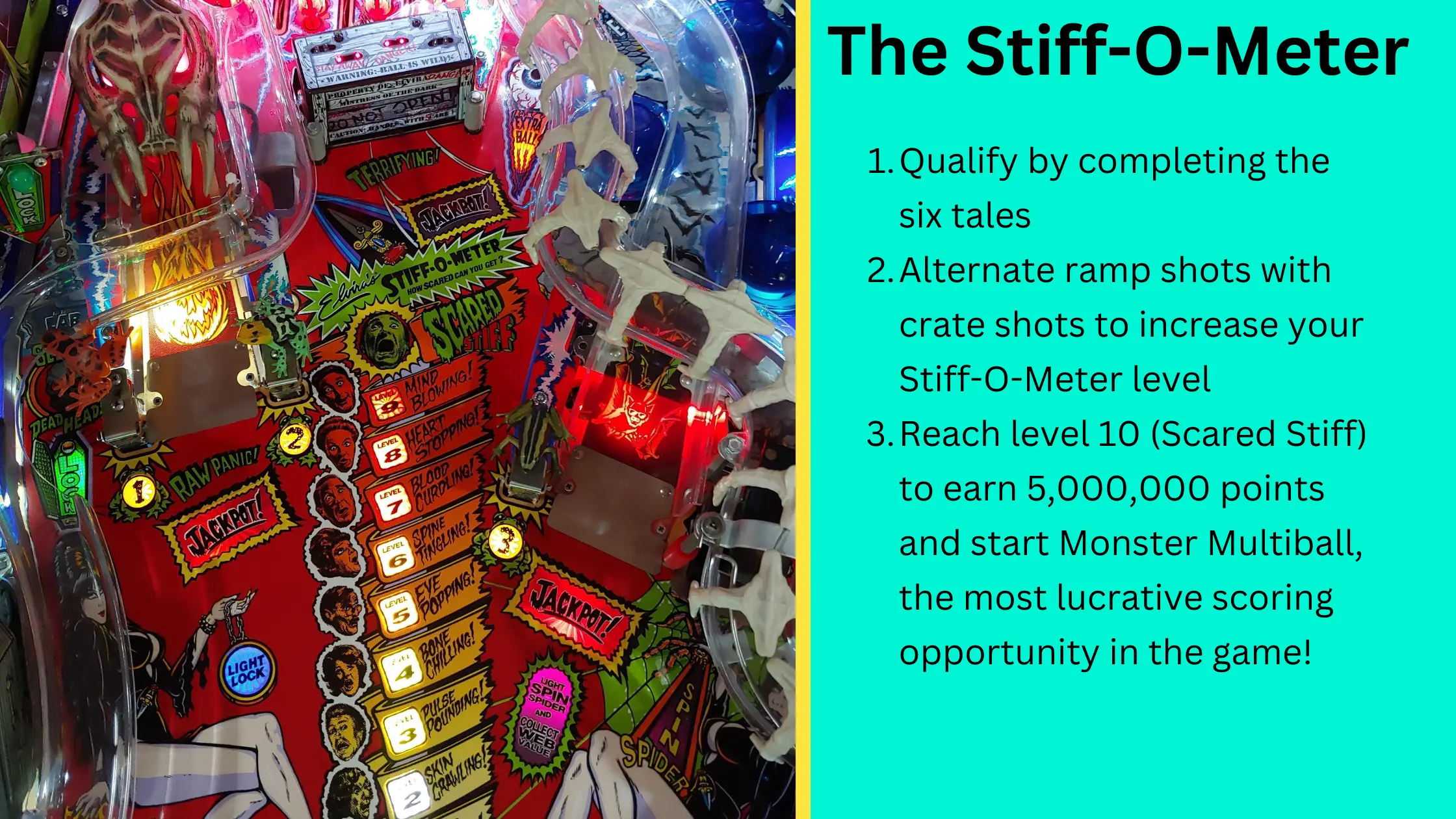
The best way to destroy Monster Multiball is to trap up every ball but one on either flipper and then use the other flipper to loop the same ramp over and over again. It’s tough to set yourself up for that, but it’s a very safe way to score million after million. Alternatively, you can juggle ramps if you’re comfortable with that, or if for some reason, you find repeatedly hitting the crate easiest, you can do that, too. Basically, come up with a way to repeatedly hit one of the three shots over and over again. The safer and more iterable the shot, the better Monster Multiball will pay off.
If you fail to reach Scared Stiff, you will save all your Stiff-O-Meter progress, but you’ll have to complete all six tales again to start up the Stiff-O-Meter again. To reiterate, playing all six tales is possible, but it’s not trivial. Doing it twice is very hard. The Stiff-O-Meter alone is worth decent value (it’s pretty comparable to Stiff in the Coffin), but Monster Multiball is the most valuable mode in the game. So, take your time to beat the Stiff-O-Meter, since losing it is very bad. That said, don’t panic too much since there are still points elsewhere.
To reiterate, getting three tales is pretty easy since Stiff in the Coffin more or less gives you Eyes of the Bony Beast along the way, and Night of the Leapers is basically guaranteed to start just by playing a multiball. The other three are trickier; the Lab and the Deadheads both require shots to the loops, which don’t really give you anything else of value, and Crate is both not worth very much and difficult to start. Still, it can be worth going for if you get close just by accident or if you get those Web advances which can make it easier to start.


No comments yet. Sign in to be the first.